
Context
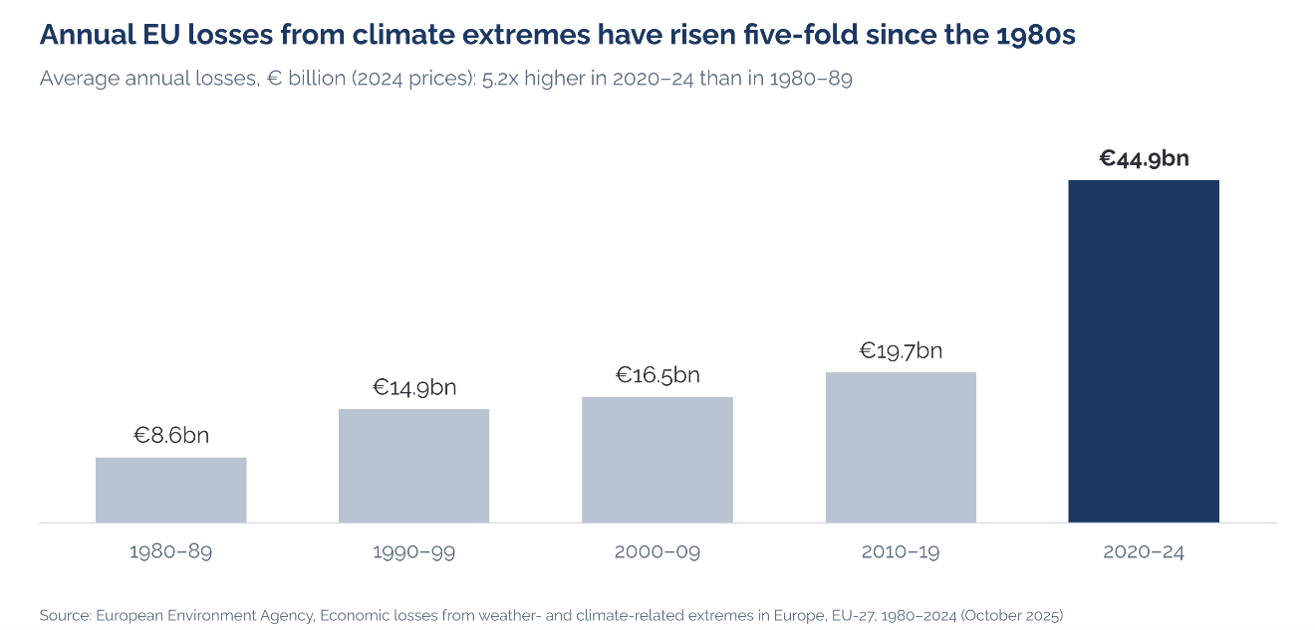
Weather and climate extremes cost the EU €822 billion (around £687 billion) between 1980 and 2024, with a quarter of that - €208 billion (£173 billion) - lost between 2021 and 2024 alone. That’s an average of around €45 billion a year in recent years, five times the 1980s level. And as this includes only direct physical damage caused by weather and climate extremes, is, according to the European Environment Agency, most likely a conservative estimate that misses out on losses related to productivity, injuries, healthcare costs, and importantly, loss of life due to excess heat, Europe's deadliest climate hazard.
In the summer of 2026 heat was linked to an estimated 50,391 deaths across 854 European cities between June and August, one of the highest tolls ever recorded. Imperial College estimates that around 65% of those deaths - that’s 32,619 people - would not have happened without climate change.
Introduction
Against this backdrop, the European Commission has published its Framework for Climate Resilience, whose central goal is to strengthen “Europe’s ability to anticipate and manage climate risks, protect people and places, and prevent avoidable damage”.
The proposed law is addressed to public authorities e.g. governments, regions and cities, not companies or investors. But it will shape the data, assumptions and expectations that sit behind the physical climate risk analysis processes used by companies and investors across Europe. And as such its likely to have an impact on what information they need to collect and how they think about adaptation and resilience going forwards.
This article explains what the framework is, why it matters and how firms can prepare.
What is the EU Climate Resilience Framework?
The framework is a package of four parts including a Communication entitled A Resilient Europe for a Changing Climate, a draft Regulation establishing a European Climate Resilience Law, an impact assessment, and a set of non-legislative initiatives.
At its core, the framework aims to shift the EU from reacting to climate disasters to anticipating and managing climate risk, by giving everyone the same planning assumptions and clear responsibility for acting on them.
The main elements include:
A reference warming trajectory: a common, science-based planning baseline of 1.5°C by 2030, 2°C by 2050 and 3°C by 2100. This is a planning assumption, not a target and public authorities are expected to use it in budgeting, spatial planning and impact assessments.
Clear risk owners: Member States must name who is responsible for managing each major climate risk, at each level of government.
Better, comparable risk assessments: Member States will need to publish a national climate risk assessment every five years (similar to the UK’s obligations under the Climate Change Act), aligned with an EU-wide assessment from the European Environment Agency. These will identify and prioritise each country’s main climate risks and feed directly into its national resilience plan.
A single national resilience plan: Member States will need to produce a single strategic plan, replacing other existing planning documents. Due by the end of 2030 and updated every five years, the plan will set out measures, timeframes, costs and funding, and name who is responsible for each major risk.
Simpler monitoring: Member States will report on resilience progress every two years from 2029 through a single channel, replacing duplicate reporting under existing EU rules and allowing progress to be tracked at national and EU level.
Alongside the law, the Commission announced a set of public tools, including the European Climate Viewer, which maps projected hazards by region, period and sector, and the Navigator of Climate Resilience Tools, which helps public authorities find adaptation solutions suited to their territory, sector and vulnerabilities.
Why does it matter?
Assessing physical climate risk is no longer a long-term scenario exercise. As we’re all increasingly aware, especially after the summer just gone, climate-related impacts and losses are very much a today problem. Europe is warming at roughly twice the global average rate, and the Commission estimates that this year’s heatwaves alone cost €113 billion in lost output, with drought losses potentially reaching a further €90 billion. Despite this, we also know that only around a quarter of natural catastrophe losses in the EU have historically been insured, leaving businesses and governments to absorb most of the cost.
The Commission also estimates adaptation investment needs at around €70 billion a year, with returns of two to ten times the outlay in avoided damage. It also puts the global market for resilience products and services at €3.5 trillion by 2050.
What does it mean for UK investment managers, private equity firms, and their portfolio companies?
The draft law creates no new obligations for investors or companies, and the UK is outside its scope. However, for firms with European exposure, it will change the data, costs and expectations they operate within.
For portfolio companies and physical assets in the EU
More visible risk: national risk assessments and the Climate Viewer will publish where hazards are concentrated, making exposed sites easier for insurers, lenders and customers to identify. Over time this may feed into planning decisions, infrastructure spending and asset values.
Insurance cost and availability: with only around a quarter of catastrophe losses insured, the Climate Insurance Alliance and EIOPA’s (the European Insurance and Occupational Pensions Authority) work will shape what cover is available and at what price. Expect insurers to ask more about physical risk and prevention.
Operations and supply chains: use of the warming trajectory in spatial planning may affect where companies can build or expand, and better hazard data may expose vulnerable suppliers and logistics.
For investment managers and PE firms
Valuation and due diligence: a common warming trajectory and public hazard data, alongside the Commission’s plans to reflect physical risk in valuation and accounting, give buyers, lenders and auditors a shared reference point. As a result, assessment of physical risk may come to feature more in deal pricing, financing terms and exits.
A higher bar for analysis: some firms test portfolios against lower-warming scenarios, such as the NGFS Net Zero 2050 scenario, which limits warming to 1.5°C. The EU’s planning baseline assumes 2°C by 2050 and 3°C by 2100, so assessments relying only on milder assumptions may increasingly be seen as understating risk, particularly for long-lived assets.
LP expectations: many European LPs already ask about physical risk. Public, EU-endorsed data will make it easier for them to compare managers and harder to justify a light-touch approach.
Opportunity: resilience and adaptation also offer opportunities. With the EU needing around €70 billion of investment a year, and public funding and tax incentives on the way, demand for solutions in water, cooling, resilient infrastructure and climate data is set to grow.
For UK firms, this sits alongside FCA climate reporting and the UK Sustainability Reporting Standards, which already expect firms to assess and disclose material physical risks. The EU framework doesn’t change those rules, but it raises the bar on what good practice looks like.
How to prepare
The main legal milestones fall between 2028 and 2030, but the data and expectations will build well before then. Practical steps firms can take now:
Map your European exposure. Identify portfolio companies’ key physical assets and suppliers in the EU, and their locations. This is the foundation for any physical risk assessment work.
Conduct or refresh a physical risk assessment. Screen assets against acute and chronic hazards such as heat, drought, flood and wildfire. And if you’re doing scenario analysis, make sure you’re including the EU's reference trajectory (2°C by 2050, 3°C by 2100) so your analysis is comparable with public data.
Build physical risk into the deal cycle. Add location-based hazard screening and insurance review to due diligence, and resilience measures to 100-day plans and value creation work.
Engage portfolio companies. Ask about long term insurance cover, business continuity and adaptation plans, starting with the most exposed assets.
Look at the opportunity side. Consider where resilience solutions fit your strategy, and track the Taxonomy revisions and EIB co-financing as they develop.
Get your reporting ready. Make sure physical risk analysis flows consistently into FCA climate reporting, UK SRS, LP questionnaires and any EU reporting, to minimise the reporting burden.
Watch the legislative process. Keep and eye changes that may come out in the negotiation. We’ll also keep you up-to-date on this.
Our view
The Climate Resilience Framework marks a shift in how the EU thinks about adaptation and resilience, treating it more than ever as an economic and security priority rather than solely an environmental one. And while the framework doesn’t apply to investors directly, it will create the shared assumptions and public data that lenders, insurers, buyers and LPs will increasingly use to judge physical risk. Firms that build this into their investment process now will be better placed to protect value and to spot opportunities as the resilience market grows.
If you would like to discuss how the framework might affect your firm or portfolio, please get in touch.
Further Reading